

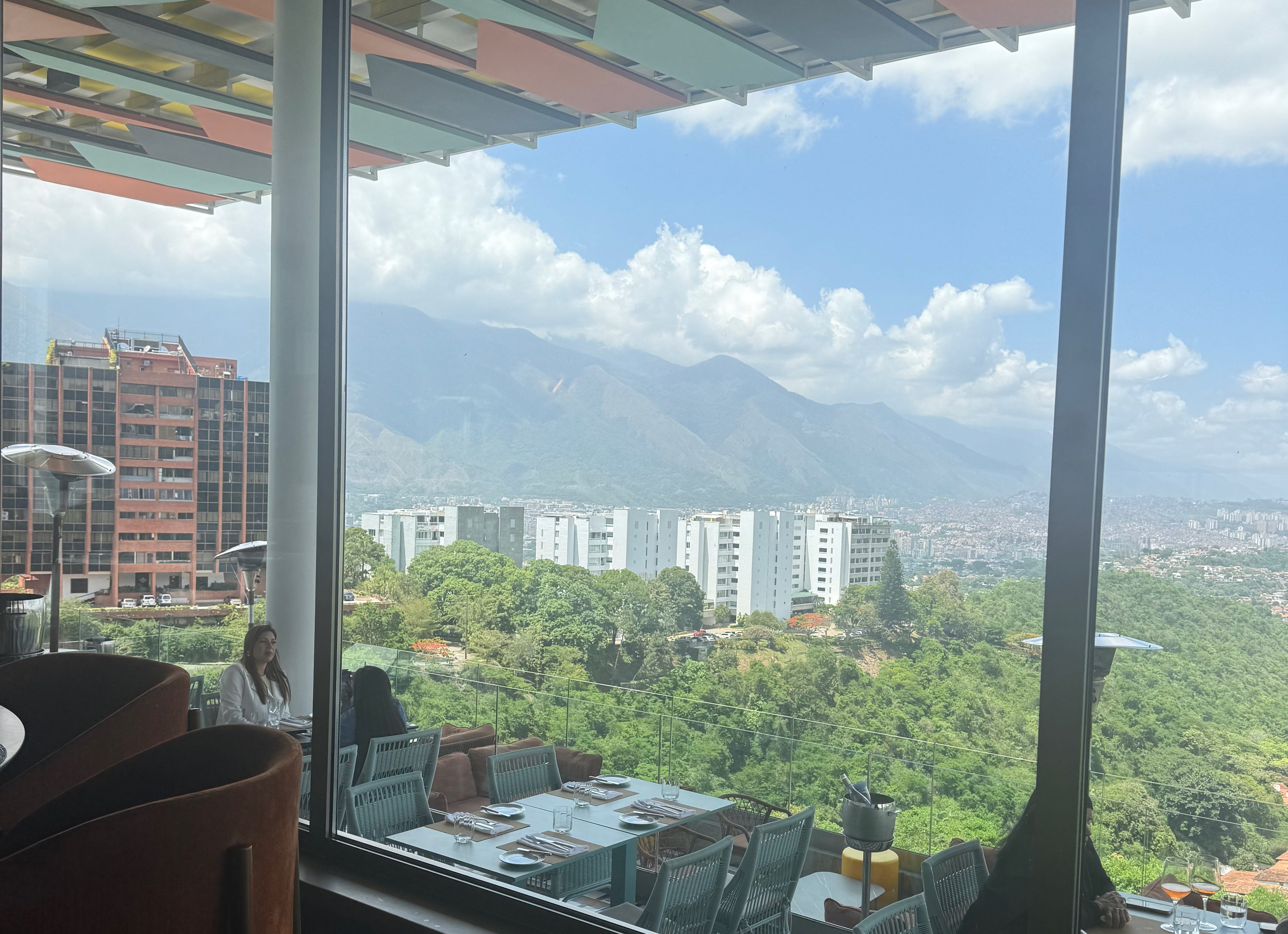
Last week, I traveled to Venezuela to attend the first-ever Venezuela Tech Week in Caracas and spend time understanding the current state of the country from a technology, business, and infrastructure perspective.
The trip was partly personal, partly professional, but mostly exploratory. After spending the last 18 years building my career in the United States, working across software, cloud, AI, and digital transformation, I wanted to better understand how I could align my new business with the long-term recovery and modernization of Venezuela.
And after spending time there, one thing became very clear:
Venezuela is entering a new era.
An era filled with enormous challenges, but also enormous opportunity.
Starting With Family, Friends, and Perspective
The trip started in the best possible way: reconnecting with old friends and family.
For the first time in probably 18 years, I got to spend Mother’s Day in Venezuela with my mom and family. That alone made the trip worth it. There’s something grounding about coming back home; hearing familiar accents, seeing old friends, revisiting places that shaped you, and realizing how much has changed while somehow feeling exactly the same.
Those first few days were less about business and more about perspective. Conversations with friends quickly shifted into discussions about the country, the economy, technology, entrepreneurship, and what the future could realistically look like.
And the recurring theme was clear: people are cautiously optimistic again.
Venezuela Tech Week: Imperfect, But Important
The main reason for the trip was attending Venezuela Tech Week, the country’s first large-scale technology and entrepreneurship conference focused on innovation, startups, investment, and economic development.
The idea behind the event was genuinely great.
The conference combined Venezuela Tech Week with the International Entrepreneurship Congress, bringing together entrepreneurs, investors, operators, policymakers, and technologists from across Latin America. There were attendees from Colombia, Argentina, and other regional ecosystems, which created an interesting mix of perspectives and networking opportunities.
That said, the event itself still felt early.
The organization lacked some structure, and many of the talks remained relatively high level without going very deep technically. I also felt the conference leaned too heavily into politics at times, when there was an opportunity to focus more aggressively on technology, venture capital, infrastructure, and practical innovation.
I believe a more execution-focused and less political approach could attract significantly more international VCs, operators, and technology partners in future editions.
But despite those shortcomings, the energy around the event mattered.
Because for the first time in a long time, there was a real attempt to position Venezuela as part of the broader Latin American technology conversation. And that is important.


The networking was probably the strongest part of the conference. I had conversations with founders, operators, engineers, consultants, and executives all trying to solve similar problems:
How do we modernize legacy companies?
How do we move organizations to the cloud?
How do we modernize outdated tech stacks?
How do we prepare companies for AI and automation?
How do we create systems that can scale in a country with infrastructure instability?
The reality is that many private companies in Venezuela are still extremely early in their digital transformation journey. In some sectors, companies are years behind modern cloud and data practices.
And while that creates challenges, it also creates massive opportunity.
The leapfrog potential is real.
AI, Modernization, and the Opportunity Ahead
One thing that became obvious during many of these conversations is that Venezuela may actually have an opportunity to skip certain stages of technological evolution entirely.
A lot of companies are still modernizing foundational systems, but at the same time, the global AI wave is happening now. That creates a unique moment where organizations can rethink workflows from scratch instead of layering AI on top of decades of technical debt.
There is enormous opportunity in:
AI-assisted operations
Automation workflows
Modern cloud infrastructure
Data platforms
Fintech modernization
Government and public-sector digitalization
Energy technology and grid innovation
Especially in the public domain, the amount of operational inefficiency and manual process still present means the upside for technology adoption is massive.
Conversations About the Economy
One of the most interesting parts of the trip was meeting with the vice president of a major Venezuelan bank.
We spent hours discussing the economy from both a macro and micro perspective: the evolution of the private sector, the realities of operating businesses in the country today, currency exchange dynamics, investment appetite, and the short- and long-term outlook for Venezuela.
The overall sentiment I encountered across many conversations was nuanced:
The country still faces enormous structural challenges.
Infrastructure remains fragile.
Access to capital is limited.
Institutional trust still needs rebuilding.
But at the same time, there is growing entrepreneurial activity, increasing private-sector participation, and a clear desire for modernization.
That said, it’s impossible to ignore that long-term investment and large-scale rebuilding will ultimately depend on stronger legal and institutional frameworks. Serious capital needs predictability, protections for investors, and policies that encourage entrepreneurship instead of penalizing it.
While there are still no definitive structural changes that fully guarantee those conditions, there are early signals of movement in certain sectors. The oil and gas industry, for example, has already started to see regulatory and investment shifts aimed at reopening the country to outside participation and capital.
My personal belief is that these types of changes will gradually expand into other industries over time. And even before that happens at scale, Venezuelans abroad can already begin contributing by building businesses, creating jobs with strong salaries, transferring knowledge, and helping improve quality of life for people inside the country.
Recovery will not happen overnight, and it will not come from any one sector alone. It will come from thousands of people deciding to build again.
Energy: The Country’s Biggest Problem, and Biggest Opportunity
If there was one topic that consistently overshadowed everything else, it was energy.
The electricity situation remains extremely difficult. Blackouts continue across many parts of the country, in some places lasting for long periods of time. Reliable infrastructure remains one of the largest bottlenecks to growth.
But it is also where I see one of the biggest long-term opportunities.
Toward the end of the trip, I met with an expert deeply involved in the Venezuelan energy sector. We discussed both the tactical needs of today and the long-term vision for the future: modernization, grid resilience, renewable energy, operational technology, and the role software and AI can play in transforming infrastructure.
Energy has been a major focus of my work over the last three years, particularly around digital transformation and AI initiatives in the sector, so these conversations were especially meaningful to me.
The challenges are enormous.
But so is the potential impact.
A Country That Will Need All of Us
I left Venezuela with mixed emotions: hope, excitement, concern, nostalgia, and motivation.
What became clear to me is that the country’s recovery, if it continues moving in the right direction, will require the participation of Venezuelans everywhere: entrepreneurs, engineers, operators, investors, builders, and professionals across every industry.
Not because anyone is coming to “save” the country, but because rebuilding systems, institutions, infrastructure, and businesses at scale takes collective effort.
There is still a very long road ahead.
But for the first time in a while, it feels like there is movement.
Like the country is beginning to reopen itself to the future.
I spent the last few days of the trip visiting the beautiful Morrocoy National Park and the kitesurfing town of Adícora, two places that reminded me yet again of the incredible natural beauty Venezuela possesses. But during those travels, I also experienced the country’s infrastructure challenges firsthand. Recurring blackouts remain a part of daily life in many areas, sometimes lasting for hours at a time. And on one stretch of the trip, we traveled nearly five hours without finding a single gas station that actually had fuel available. It was a stark reminder of how deep the infrastructure crisis still runs across the country.
It became impossible to ignore how foundational infrastructure truly is for everything else the country hopes to rebuild. Tourism, technology, industry, entrepreneurship, and investment all depend on reliable energy, transportation, connectivity, and public services.


At the same time, those experiences reinforced my optimism. Because if Venezuela can begin solving these core infrastructure problems, the upside across every sector of the economy could be enormous. Beyond technology, energy, and infrastructure, it’s impossible not to see the massive long-term opportunity in tourism as well. From beaches and mountains to culture and hospitality, Venezuela still has all the ingredients to become one of the most unique destinations in the region again.
And while the path will not be linear, I genuinely believe Venezuela has the talent, resilience, and creativity to build something remarkable again.
We are entering a new era, one filled with both opportunities and challenges, and I’m optimistic that, over time, we will once again see a beautiful, thriving, and prosperous Venezuela.