

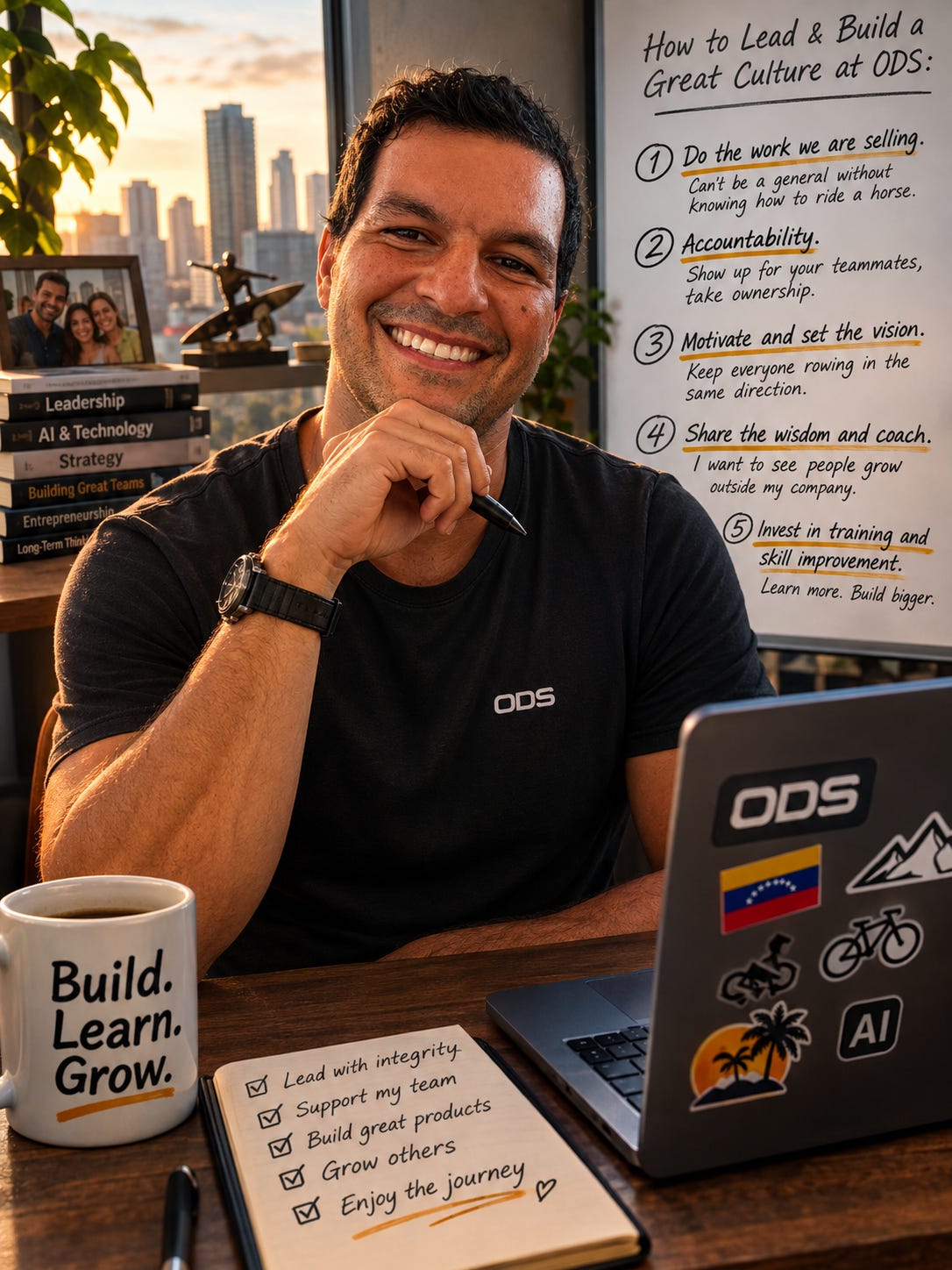
I’ve been thinking a lot lately about leadership and, more specifically, about where my own management style came from.
The truth is that very little of it is original.
Over the years, I’ve worked in large corporations, consulting firms, and now my own company. Along the way, I’ve had great managers, difficult managers, mentors, colleagues, clients, and teammates who all shaped the way I think about leadership. Sometimes I learned from something someone did exceptionally well. Other times, I learned because I knew I wanted to do things differently when I eventually had the opportunity.
Today, as I build ODS, I find myself borrowing pieces from all of those experiences.
I’m still figuring it out, and I’m sure my philosophy will continue to evolve. But there are five principles that increasingly define the kind of leader I want to be and the culture I want us to build.
1. Never get too far away from the work
There is an Elon Musk quote I’ve always liked: “You can’t be a cavalry general if you don’t know how to ride a horse”
That idea has stayed with me.
One of the things I appreciated about consulting was that the best leaders I worked with understood the work their teams were selling. They might not have been writing every line of code or building every presentation anymore, but they could sit with a client, understand the problem, challenge an approach, and help the team when things got difficult.
I believe strongly in that.
If ODS is selling AI systems, I want to understand how those systems are built. If we’re building software, I want to understand the architecture. If we’re helping a client solve a data problem, I want to be able to sit with the engineers and understand what is actually happening.
That doesn’t mean the CEO should do everyone’s job. In fact, learning to delegate has probably been one of the harder parts of building a company.
But there is a difference between delegating the work and becoming disconnected from it.
Especially in technology today, where things are changing so quickly, leaders can’t afford to stop learning. Coding agents are improving every month. AI tools are changing how software gets built. The distance between an idea and a working product keeps getting smaller.
I never want to become the person selling something I no longer understand.
2. Accountability starts with you
Accountability is one of those words that every company puts somewhere in its values.
To me, it is much simpler: Show up.
Do what you said you were going to do. Take ownership when something goes wrong. Help your teammates when they need you. And never ask someone to do something you wouldn’t be willing to do yourself.
Consulting taught me a lot about this because clients don’t particularly care whose fault something is. They hired you to solve a problem.
That mentality has influenced how I try to operate today.
If a project is struggling, my first instinct shouldn’t be to ask who made the mistake. It should be to understand what happened and what I can do to help fix it. There will be time afterward to improve the process, give feedback, or determine what should have happened differently.
And accountability becomes much easier to ask from others when they see it coming from leadership first.
If I expect someone to work through a difficult client situation, I need to be willing to get on that call with them. If there is uncomfortable work that needs to get done, I can’t disappear because I have a CEO title.
Culture is shaped much more by what leaders do than by what they say.
3. Give people a goal worth rowing toward
I’ve also learned that people perform much better when they understand where they are going.
Leadership isn’t just assigning tasks. It is setting the goalpost.
Why are we building this? Why does it matter to the client? What are we trying to become as a company? What does great look like?
One of the easiest ways for a team to become inefficient is for everyone to be working hard in slightly different directions.
I’ve seen this happen in large organizations, where incredibly talented people spend enormous amounts of energy on work that ultimately doesn’t move the organization forward. Usually it isn’t because people aren’t capable. It is because the vision isn’t clear enough.
I think one of the most important jobs of a leader is to continuously create that clarity.
The analogy I always come back to is rowing. You can have the strongest rowers in the world, but if everyone is rowing in a different direction, the boat isn’t going anywhere.
My job is to make sure we know where the boat is going, and hopefully give people a reason to want to help us get there.
4. Share what you know
Some of the most influential people in my career were people who had absolutely no obligation to teach me anything. They simply did.
They explained how they approached a difficult client conversation. They brought me into meetings I probably wasn’t senior enough to attend. They reviewed my work. They challenged the way I thought about a problem. They introduced me to people. Sometimes they gave me opportunities before I felt completely ready for them.
Those moments compounded over time.
It is one of the reasons I believe so strongly in coaching and knowledge sharing today.
If I learn something that could save someone on my team six months of mistakes, why would I keep it to myself?
There is sometimes an insecurity in leadership where people feel that keeping knowledge makes them more valuable. I think the opposite is true.
A good leader should constantly be trying to make themselves less necessary.
Teach people how you think. Explain why decisions are made. Give people context instead of just instructions. Let them make decisions. Let them make mistakes. Then help them understand what they could do differently next time.
The goal shouldn’t be to create followers.
It should be to create more leaders.
5. Be proud when people outgrow you
This might be the principle I care about the most as I think about the culture I want to build at ODS.
I want people to grow here.
That means investing in training, certifications, new tools, better equipment, mentorship, and opportunities to work on things that stretch their abilities. Technology moves too quickly for professional development to be something people do once a year during a corporate training week.
Learning has to be part of the job.
But there is another side to investing in people that companies sometimes don’t like talking about.
If you make someone dramatically better, they may eventually leave.
I’m okay with that.
Obviously, I want great people to stay at ODS. I want to build a company where talented people can have long careers, do interesting work, earn more responsibility, and share in our success.
But if someone works with me for three or five years and eventually gets an opportunity to start their own company, become a CTO somewhere, double their salary, or pursue something they have always wanted to do, I would consider that a success.
I would be incredibly proud.
Some of the people who helped me most in my career weren’t trying to make sure I worked for them forever. They were trying to help me become better.
I want to pay that forward.
The culture is the accumulation of small things
Running a company has made me realize that culture isn’t something you design during an offsite and put into a PowerPoint.
It is what happens every day.
It is whether you answer the phone when a teammate needs help. Whether you take responsibility when a client is unhappy. Whether you understand the work your company is selling. Whether people know where the company is going. Whether you make time to teach someone something even when doing it yourself would be faster.
And ultimately, it is whether the people who spend part of their careers working with you leave better than when they arrived.
I’ve been fortunate to work with a lot of people who shaped the way I think about leadership. I’m sure I’ll continue borrowing lessons from others for the rest of my career.
Maybe that is another leadership lesson in itself.
Never assume you’re done learning.
Sharing knowledge and building more leaders is my favorite of all 😇✨
Great perspective points on leadership, definitely resonate with them!! :)