

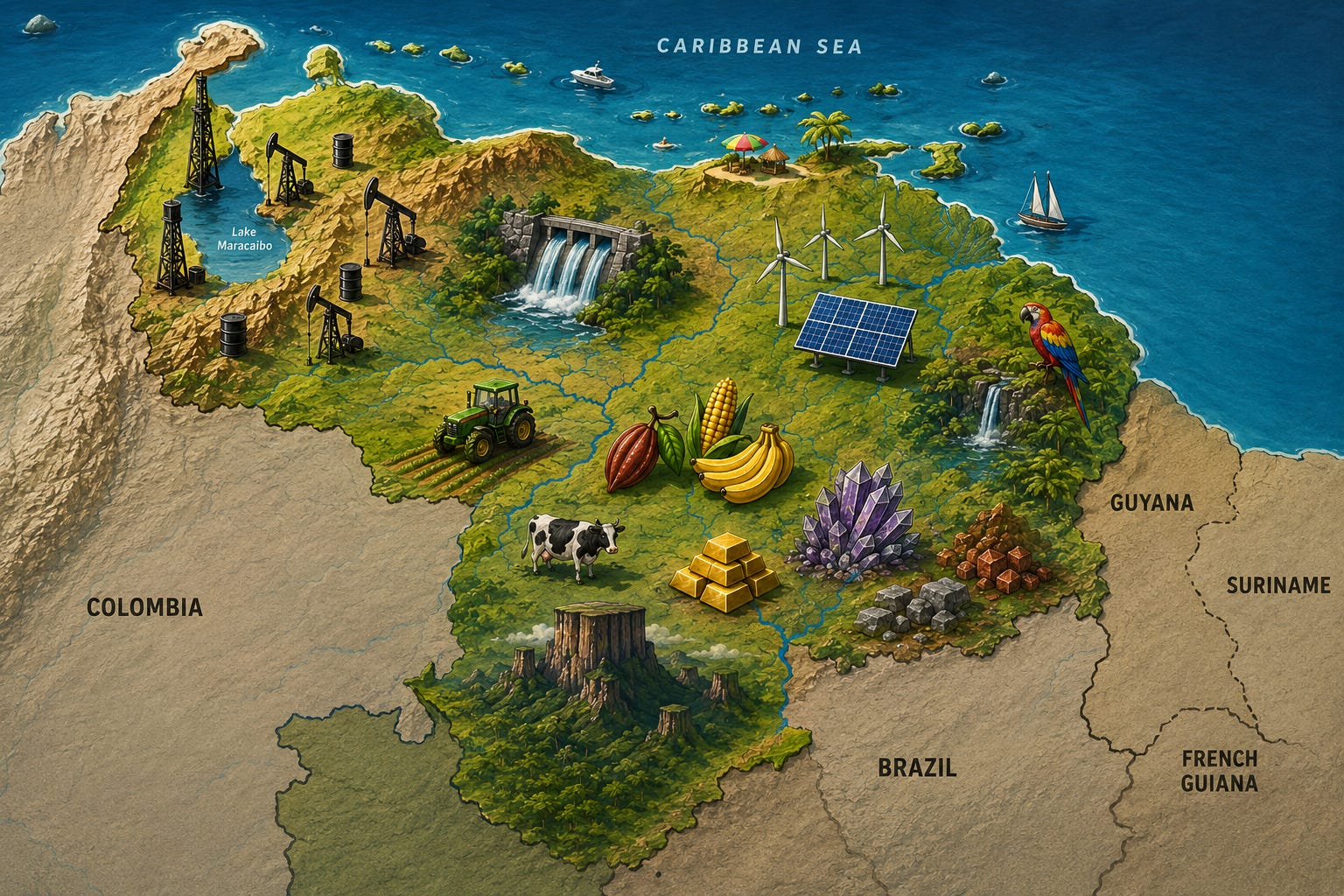
One of the questions I’ve been asked most often since returning from Venezuela is why I’ve become so optimistic about the country’s future. It’s a fair question because, on the surface, very little has changed. The country continues to face enormous political, economic, and institutional challenges, and the recent earthquake only made the road to recovery even more difficult. If anything, the headlines would suggest that now is the worst possible time to be talking about opportunity. Yet the more time I spend learning about Venezuela, the more convinced I become that understanding the country’s long-term potential is one of the most worthwhile things I can be doing right now.
What’s interesting is that this optimism isn’t new. I didn’t suddenly discover that Venezuela has abundant natural resources or a strategic geographic location. Like most Venezuelans, I grew up hearing that we lived in one of the richest countries in the world. I knew we had oil. I knew we had fertile land, hydroelectric power, beautiful beaches, mountains, and extraordinary biodiversity. Those weren’t revelations. What changed over the past year wasn’t my belief that Venezuela has potential. What changed was my decision to stop treating that potential as an abstract idea and start understanding what it actually means.
That shift happened for a practical reason. When I started ODS earlier this year, I wasn’t thinking about Venezuela as a topic to write about. I was thinking about it as a place where I genuinely wanted to build. If I was serious about hiring talent, investing my time, developing partnerships, and eventually contributing to the country’s reconstruction, then I needed to answer a much harder question than whether Venezuela had opportunity. I needed to understand where those opportunities actually were, which industries mattered most, what problems were worth solving, and where someone with my background in technology could make a meaningful contribution. General optimism wasn’t enough. It needed to become informed conviction.
That realization completely changed the way I approached my time in Venezuela. Venezuela Tech Week became less about attending talks and more about meeting people. I deliberately spent time with founders, engineers, investors, operators, academics, and business leaders, asking as many questions as I could. What surprised me wasn’t that everyone shared the same perspective, they didn’t. It was that almost every conversation revealed another layer of the country that I hadn’t fully appreciated before. One person would talk about natural gas, another about tourism, another about agriculture, another about logistics. At first those felt like independent conversations. Eventually I realized they were all describing different pieces of the same system.
When I came back to Miami, those conversations didn’t end. They became the starting point for a much deeper process of learning. Over the past several months I’ve found myself reading industry reports that I never imagined I’d care about, studying maps of pipelines and electrical grids, looking at agricultural production, shipping routes, mineral deposits, weather patterns, and demographic trends. I’ve also been incredibly fortunate to spend time learning from people who have dedicated their careers to understanding these industries. One of the people who has had the biggest influence on my thinking throughout this process has been David Moran, an energy expert who has spent decades working in the field and understands Venezuela’s energy ecosystem better than almost anyone I’ve met. Over the past several months, David has been incredibly generous with his time, sharing his vision for the country’s future and helping me understand the opportunities that exist across the energy sector, particularly in renewables.
Before these conversations, I tended to think about Venezuela’s energy story primarily through the lens of oil. David helped me see a much broader picture. We’ve talked about natural gas, hydroelectric power, solar, wind, energy storage, grid modernization, desalination, and how all of those pieces could work together as part of a modern energy strategy. More importantly, he has helped me understand not only what resources Venezuela possesses, but why they matter and how they could become the foundation for entirely new industries over the coming decades.
That interconnectedness is probably the biggest lesson I’ve learned so far. It’s easy to think about oil, tourism, agriculture, mining, technology, or infrastructure as separate industries competing for attention. In reality, they reinforce each other. Affordable and reliable energy makes manufacturing viable. Manufacturing creates demand for better logistics. Better logistics improve exports and agriculture. Technology increases productivity across every sector. Education develops the engineers, scientists, and entrepreneurs who make all of those industries more competitive. Prosperity isn’t the result of one successful industry. It’s the result of an ecosystem where each part strengthens the others.
That perspective has also changed the way I think about Venezuela’s greatest asset. Most people would probably answer oil, and it’s certainly one of the country’s defining resources. But the more I study Venezuela, the more convinced I become that its greatest advantage is its people. Over the past twenty-five years, millions of Venezuelans have built remarkable careers across the world. They’ve become engineers, founders, physicians, researchers, executives, investors, and scientists. They haven’t stopped contributing to Venezuela simply because they live somewhere else. Many are already investing, mentoring, advising, building businesses, or sharing knowledge from abroad. If the country is able to create the right environment over time, that global network of talent could become one of its most valuable competitive advantages.
This is ultimately why I’ve decided to write this series. I’m not trying to convince anyone that Venezuela’s future is guaranteed, and I’m certainly not suggesting that the challenges are behind us. If anything, the earthquake reminded all of us how much work remains. My goal is much simpler. I want to document what I’m learning as I try to understand where Venezuela’s opportunities lie and how someone like me can contribute to them. Some of these ideas may prove wrong. Others may evolve as I continue learning. But I suspect that process of learning in public is more valuable than pretending I’ve already reached the destination.
The next article will begin where almost every conversation about Venezuela begins: energy. But instead of looking at oil in isolation, I want to explore why Venezuela’s energy ecosystem (from oil and natural gas to hydroelectric power, renewables, and the infrastructure that connects them) may be one of the country’s greatest enablers for everything that comes next.