

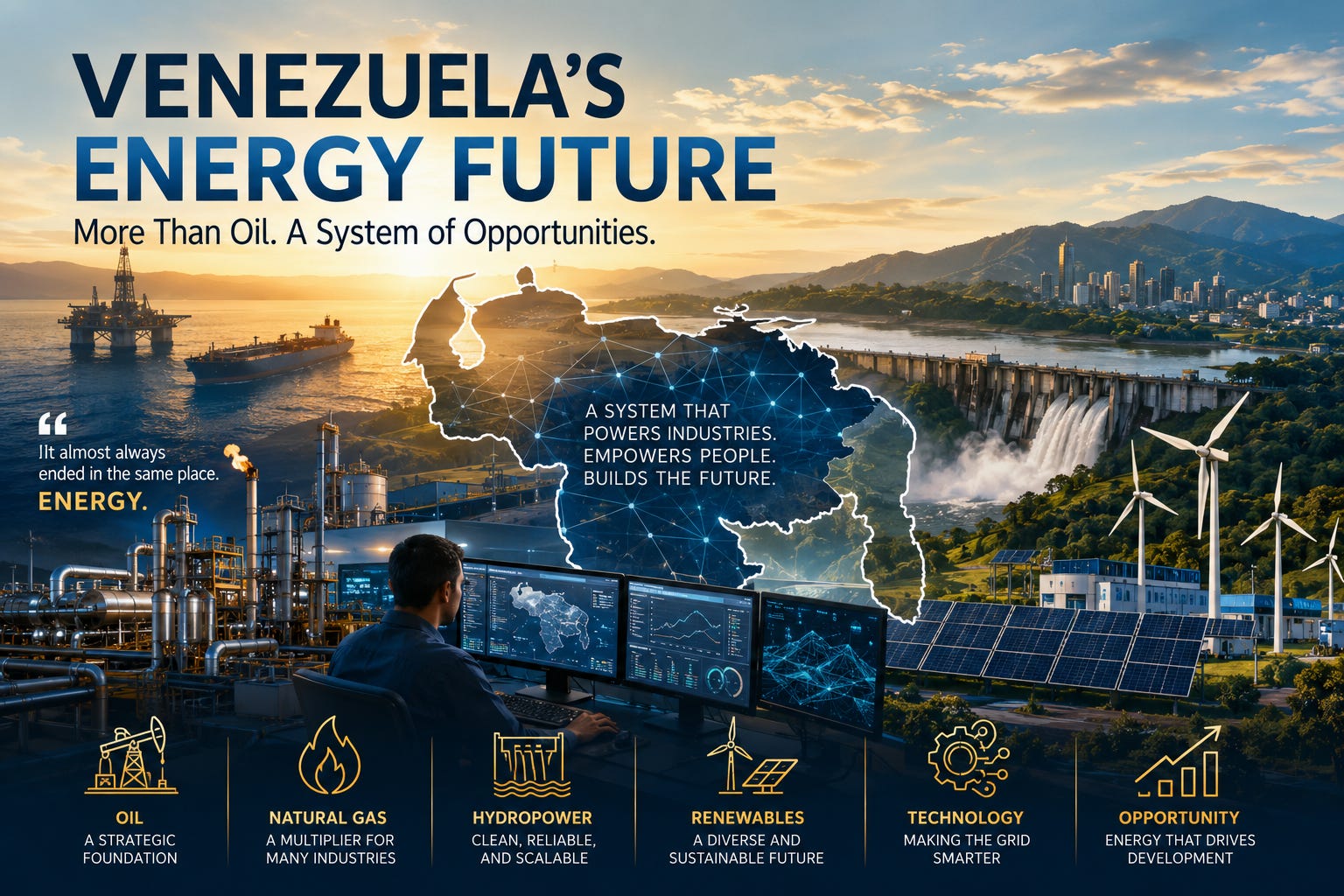
In the previous article, I wrote about why I’ve become increasingly optimistic about Venezuela’s future. That optimism isn’t rooted in politics or nostalgia. It’s rooted in something much more practical: over the past several months, I’ve made a conscious effort to better understand the country’s opportunities before deciding where I want to invest my time, my company, and ultimately my career.
That journey has taken me in directions I never expected. I’ve spent evenings reading industry reports instead of news articles, studying maps instead of headlines, and having conversations with entrepreneurs, engineers, investors, and operators who understand Venezuela far better than I do. Every discussion seemed to uncover another layer of the country that I hadn’t fully appreciated before.
What surprised me most was that regardless of where the conversation started, it almost always ended in the same place.
Energy.
It didn’t matter whether we were discussing agriculture, artificial intelligence, manufacturing, tourism, mining, desalination, logistics, or data centers. Sooner or later, every conversation came back to the same question: where will the energy come from?
That’s when I realized that if I wanted to understand Venezuela’s future, I first had to understand its energy ecosystem.
Interestingly, I approached that question from two very different directions.
Professionally, I spent several years consulting with NextEra Energy, one of the world’s largest renewable energy companies. Before working there, I thought I had a reasonable understanding of what an energy company looked like. I expected conversations about turbines, transmission lines, substations, and generation capacity.
Instead, I found myself surrounded by conversations about artificial intelligence, cloud computing, predictive maintenance, digital twins, weather forecasting, computer vision, drones, machine learning, and advanced analytics.
The longer I worked with their teams, the more I realized that NextEra didn’t think of itself simply as a company that generated electricity. It thought of itself as a technology company whose product happened to be energy.
That distinction stayed with me.
The future of energy isn’t just about building more generation. It’s about using technology to make generation more efficient, transmission more reliable, maintenance more predictive, and the entire grid more intelligent. Software has become just as important as physical infrastructure.
Around the same time I started looking more seriously at Venezuela, I also had the opportunity to begin learning from David Moran, an energy expert who has spent decades working in the sector and who has become both a mentor and a friend. David has an extraordinary understanding of Venezuela’s energy resources and has been incredibly generous sharing both his knowledge and his long-term vision for the country.
Our conversations rarely stay focused on a single topic. We may begin discussing natural gas production and end up talking about renewable energy, water infrastructure, manufacturing, AI, logistics, or economic development. What I’ve come to appreciate is that people who spend their lives working in energy don’t think in terms of isolated industries. They think in systems.
That systems perspective completely changed the way I look at Venezuela.
Like many people, I grew up thinking Venezuela’s energy story was oil. Oil certainly deserves its place in that story. Venezuela possesses the largest proven oil reserves in the world, and regions such as the Orinoco Oil Belt, Lake Maracaibo, Monagas, and Anzoátegui have supported the country’s economy for decades. Existing infrastructure, production facilities, pipelines, and refining capacity represent assets that, despite years of underinvestment, still provide an important foundation for the future.
But the more I learned, the more I realized that oil is only one chapter.
Natural gas may be one of the country’s most under appreciated opportunities. Venezuela holds the largest proven natural gas reserves in Latin America, yet much of that potential remains undeveloped. Before beginning this journey, I thought about natural gas primarily as an export opportunity. Today, I think exports are only part of the story.
Reliable natural gas can stabilize the electrical grid, support fertilizer production for agriculture, provide feedstock for petrochemical industries, power desalination plants that improve water security along the Caribbean coast, reduce methane emissions by capturing gas that is currently flared, and eventually position Venezuela as an LNG supplier to a world looking for diversified sources of energy. It isn’t simply another commodity. It’s a resource capable of enabling multiple industries simultaneously.
Hydroelectric power tells a similar story. Venezuela already possesses one of the largest hydroelectric systems in the world through the Guri, Caruachi, and Macagua dams, with Tocoma representing another important long-term opportunity once completed and fully integrated. While discussions often focus on the challenges these facilities have faced over the years, it’s easy to overlook the strategic advantage they represent. Few countries have access to this scale of renewable baseload generation. Modernizing generation equipment, strengthening transmission infrastructure, and improving operational reliability could provide Venezuela with decades of low-carbon electricity that supports both industrial development and future electrification.
Renewable energy is another area where my own assumptions have changed considerably. Before speaking with David, I largely viewed solar and wind as alternatives to fossil fuels. Today, I see them as complementary pieces of a much larger energy portfolio.
Venezuela’s geography creates exceptional conditions for utility-scale renewable generation. The Paraguaná Peninsula in Falcón receives some of the strongest and most consistent trade winds in the Caribbean, making it one of the country’s most attractive locations for wind energy development. Similar conditions exist in La Guajira, in the state of Zulia, where decades of studies have highlighted the region’s outstanding wind potential.
Solar opportunities are equally compelling. States such as Falcón, Guárico, Lara, Zulia, and Anzoátegui benefit from high levels of solar irradiation, large expanses of available land, and proximity to existing industrial corridors and transmission infrastructure. Rather than replacing oil or natural gas, these regions could complement Venezuela’s hydroelectric system by diversifying generation, improving resilience, and reducing long-term operating costs.
One idea that has consistently emerged from my conversations with David is that the future shouldn’t be framed as oil versus renewables. That’s a false choice.
The countries that will have the greatest competitive advantage are likely to be those capable of intelligently integrating multiple energy sources based on their geography, infrastructure, and economic needs. Venezuela is in the rare position of possessing world-class oil reserves, the largest proven natural gas reserves in Latin America, significant hydroelectric capacity, exceptional wind corridors, and excellent solar resources. Very few countries enjoy that level of diversification.
As I continued connecting these ideas, another realization began to emerge.
The conversation about energy isn’t really about energy.
It’s about everything energy enables.
Reliable and affordable electricity makes manufacturing more competitive. It supports modern agriculture through irrigation, fertilizer production, cold-chain logistics, and food processing. It makes desalination economically viable for coastal communities facing water challenges. It allows mining operations to become more efficient and environmentally responsible. It strengthens ports, transportation networks, telecommunications, and industrial parks.
Perhaps most interesting to me, it also creates the conditions required for entirely new industries.
Artificial intelligence is transforming nearly every sector of the global economy, but AI also has a physical footprint. Data centers require enormous amounts of electricity. High-performance computing depends on reliable power, modern transmission infrastructure, fiber connectivity, and increasingly sustainable sources of generation. Countries capable of providing abundant, affordable, and reliable electricity will become increasingly attractive locations for AI infrastructure over the coming decades.
That’s a connection I probably wouldn’t have made a few years ago.
Working with NextEra taught me that energy companies are becoming technology companies.
Learning from David has taught me that countries rich in energy resources have an opportunity to become technology platforms if they think beyond extraction and focus on value creation.
That distinction has fundamentally changed the way I think about Venezuela.
For decades, much of the national conversation revolved around what Venezuela could extract from the ground. Increasingly, I find myself asking a different question.
What can Venezuela build because of what lies beneath the ground?
Those are two very different visions for the future.
One is centered on exporting resources.
The other is centered on creating industries.
None of this should be interpreted as suggesting that success is inevitable. Energy alone will not rebuild Venezuela. Institutions matter. Education matters. Rule of law matters. Transparent regulation matters. Entrepreneurship matters. Investment matters. Without those ingredients, even the greatest natural advantages remain unrealized.
But after months of studying the country’s opportunities, I’ve become convinced that energy is where the conversation should begin. Not because it’s the only opportunity Venezuela has, but because it is the foundation upon which so many other opportunities depend.
Every industrial transformation begins with abundant and reliable energy.
If Venezuela can modernize its existing infrastructure, intelligently integrate oil, natural gas, hydroelectric power, solar, and wind, and leverage technology to manage that ecosystem more efficiently, it won’t simply rebuild its energy sector.
It will create the conditions for rebuilding much of the country’s economy.
In the next article, I’ll explore one of those opportunities in greater depth. As someone who has spent the last several years building AI solutions for large organizations, I believe artificial intelligence could become one of the most powerful accelerators of Venezuela’s reconstruction—not as a standalone industry, but as a force multiplier across energy, agriculture, healthcare, government, logistics, and entrepreneurship.