

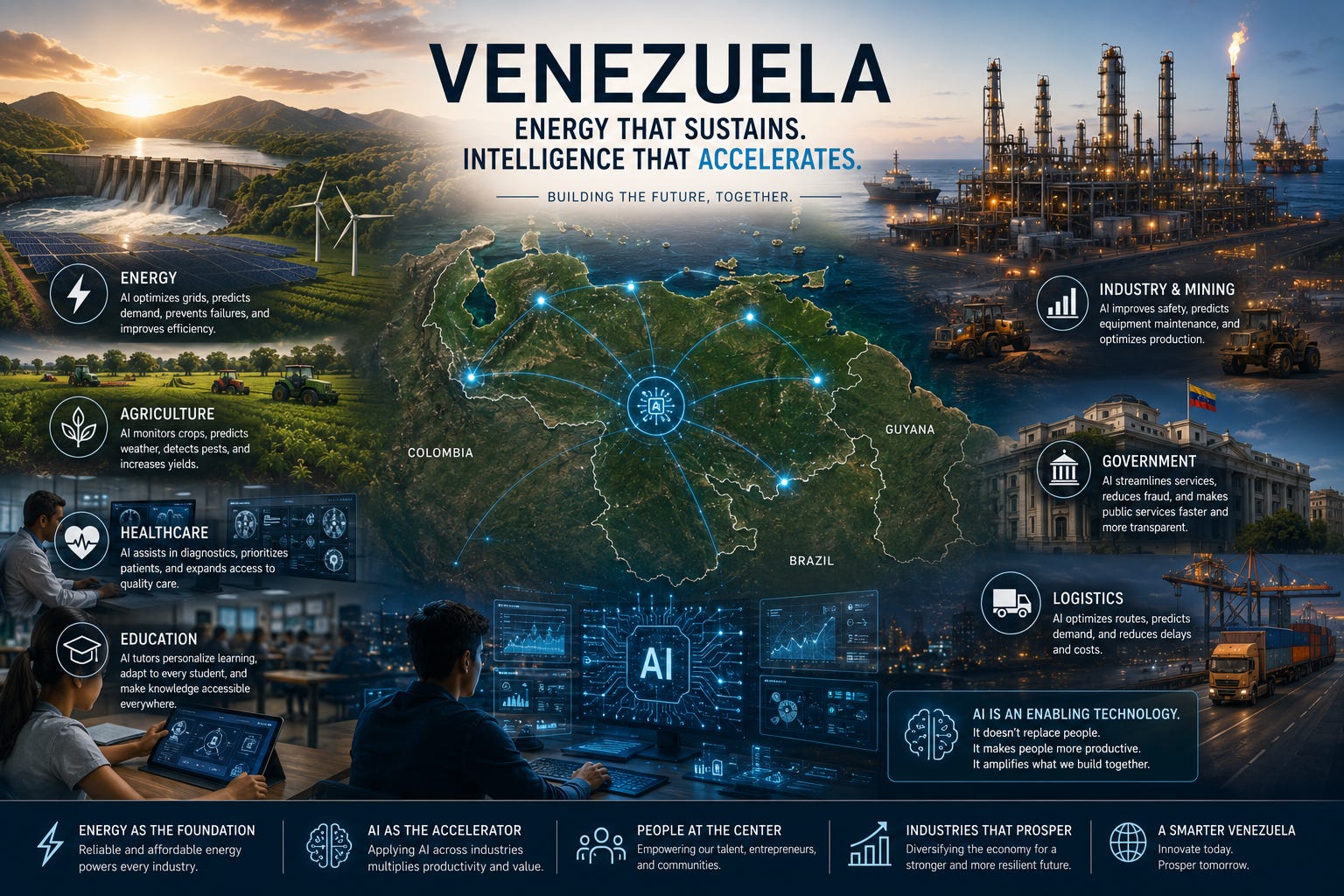
In the previous article, I argued that energy may be the most important foundation for Venezuela’s reconstruction. Reliable and affordable energy enables manufacturing, agriculture, mining, logistics, tourism, and many of the industries that could shape the country’s future. The more I studied the country’s energy ecosystem, the more I realized that rebuilding Venezuela isn’t about finding one “silver bullet.” It’s about creating the conditions that allow many different industries to grow together.
But if energy is the foundation, what becomes the accelerator?
For me, the answer is artificial intelligence.
I’ve spent the better part of the last decade helping large organizations adopt cloud computing, data platforms, and more recently artificial intelligence. During that time, I’ve watched AI evolve from a research topic into something that is beginning to transform almost every industry. What has surprised me most isn’t that AI is replacing people, but that it is making people significantly more productive. The organizations creating the most value aren’t necessarily those with the biggest AI teams. They’re the ones finding practical ways to use AI to improve decision-making, automate repetitive work, reduce costs, and help employees focus on higher-value problems.
That distinction matters because AI isn’t an industry in the traditional sense. It doesn’t compete with healthcare, energy, education, agriculture, or manufacturing. It improves all of them. In many ways, AI is becoming a horizontal capability, much like electricity or the internet. Countries that learn how to apply it broadly will likely see gains across their entire economy rather than within a single sector.
That’s why I don’t think Venezuela should ask, “How do we build an AI industry?”
I think we should ask, “How can AI make Venezuela’s existing strengths more competitive?”
Energy is perhaps the clearest example. In my previous article, I wrote about Venezuela’s unique combination of oil, natural gas, hydroelectric power, solar, and wind resources. Modern energy companies increasingly rely on AI to optimize every part of their operations. Machine learning models predict equipment failures before they happen. Computer vision systems inspect pipelines, substations, and transmission lines using drones. Weather models optimize renewable energy production. AI helps balance electrical grids, forecast demand, reduce downtime, and improve maintenance planning.
Having worked with NextEra Energy, I saw firsthand how technology has become central to operating a modern energy company. The future of energy isn’t simply about building more infrastructure. It’s about operating that infrastructure more intelligently.
The same pattern appears in agriculture. Venezuela has millions of acres of fertile land and a climate capable of supporting year-round production. AI can help farmers monitor crop health using satellite imagery, optimize irrigation, predict weather patterns, detect pests before they spread, and improve yields while reducing costs. None of those technologies replace farmers. They make farmers more productive.
Healthcare offers another compelling example. Like many developing countries, Venezuela faces shortages of specialists and uneven access to medical services. AI won’t replace physicians, but it can help prioritize patients, assist with medical imaging, summarize clinical information, expand telemedicine, and allow healthcare professionals to spend more time treating patients instead of completing administrative work.
Education may ultimately become one of the areas where AI has the greatest long-term impact. One example that caught my attention recently is Google’s new AI-powered learning experiences. Instead of simply answering questions, these tools can build personalized lessons around almost any topic, explain concepts at different levels of complexity, generate quizzes, adapt to a student’s pace, and act as an interactive tutor that is available at any time. In a world where attention spans are becoming shorter and traditional learning methods often struggle to keep students engaged, conversational AI has the potential to create a far more personalized learning experience.
Imagine what that could mean for a student in Barinas, Mérida, Ciudad Guayana, or Maracaibo who suddenly has access to an always-available tutor capable of teaching programming, physics, mathematics, English, or entrepreneurship in whatever way makes the most sense to that individual. AI won’t replace teachers, but it can amplify their impact and help make world-class educational resources accessible regardless of geography.
Government is another area where AI can quietly improve everyday life. One of the biggest frustrations citizens and businesses face in many countries isn’t the absence of services; it’s the friction involved in accessing them. AI can help automate permitting processes, improve document management, detect fraud, simplify interactions with government agencies, and make public services faster and more transparent. These improvements rarely make headlines, but they significantly improve the ease of doing business and the confidence entrepreneurs and investors have when deciding where to deploy capital.
Perhaps the opportunity that excites me most sits at the intersection of energy and artificial intelligence.
One of the biggest consequences of the AI revolution is that computing infrastructure is becoming incredibly energy intensive. Every new generation of AI models requires enormous amounts of electricity to train and operate. Data centers are already consuming unprecedented amounts of power, and that demand is expected to continue growing for years.
That’s one of the reasons I spent so much time discussing Venezuela’s energy ecosystem in the previous article. These aren’t separate conversations. Countries capable of providing abundant, reliable, and affordable electricity will become increasingly attractive locations for AI infrastructure, advanced manufacturing, and other energy-intensive industries. In many ways, AI has become another reason to modernize Venezuela’s energy sector.
One lesson I’ve learned throughout my career is that technological revolutions rarely create value on their own. Electricity transformed manufacturing. The internet transformed communication. Smartphones transformed commerce. Artificial intelligence will transform productivity. But in every case, the greatest value wasn’t created by the technology itself. It was created by entrepreneurs who figured out how to apply that technology to solve real problems.
I believe the same will be true for Venezuela.
The country doesn’t need to build the world’s leading AI model to benefit from artificial intelligence. The tools already exist, and they are becoming more capable every month. Venezuela’s opportunity is to adopt those technologies intelligently, applying them across the industries where the country already possesses natural advantages.
That’s also one of the reasons I started ODS.
While we build AI solutions for organizations across different industries, I increasingly find myself thinking about how many of those same capabilities could eventually contribute to Venezuela’s reconstruction. Whether it’s helping utilities improve operations, enabling smarter logistics, modernizing healthcare, streamlining government workflows, or giving entrepreneurs access to tools that were once available only to large enterprises, AI has the potential to dramatically lower the barrier to innovation.
For me, that’s the most exciting part of this moment.
Countries rebuilding today don’t have to recreate the infrastructure of the twentieth century. They have an opportunity to leapfrog directly to modern technologies, avoiding many of the legacy systems that wealthier nations are now spending billions to replace.
None of this happens automatically. Artificial intelligence is not a substitute for good institutions, sound economic policy, investment, education, or entrepreneurship. Technology amplifies what already exists. Used thoughtfully, it can accelerate progress. Used poorly, it can amplify inefficiency.
That’s why I don’t see AI as another industry competing for attention.
I see it as an enabling technology.
Just as electricity transformed every industry during the last century, artificial intelligence has the potential to transform every industry during this one.
If energy becomes one of the foundations of Venezuela’s reconstruction, I believe AI can become one of its greatest accelerators.
In the next article, I’ll move beyond energy and technology to explore the industries that can help diversify Venezuela’s economy over the coming decades. Agriculture, tourism, logistics, advanced manufacturing, critical minerals, and the blue economy all represent opportunities to build a more resilient and diversified country. Together, they form the next chapter in understanding how Venezuela can create sustainable, long-term prosperity.