

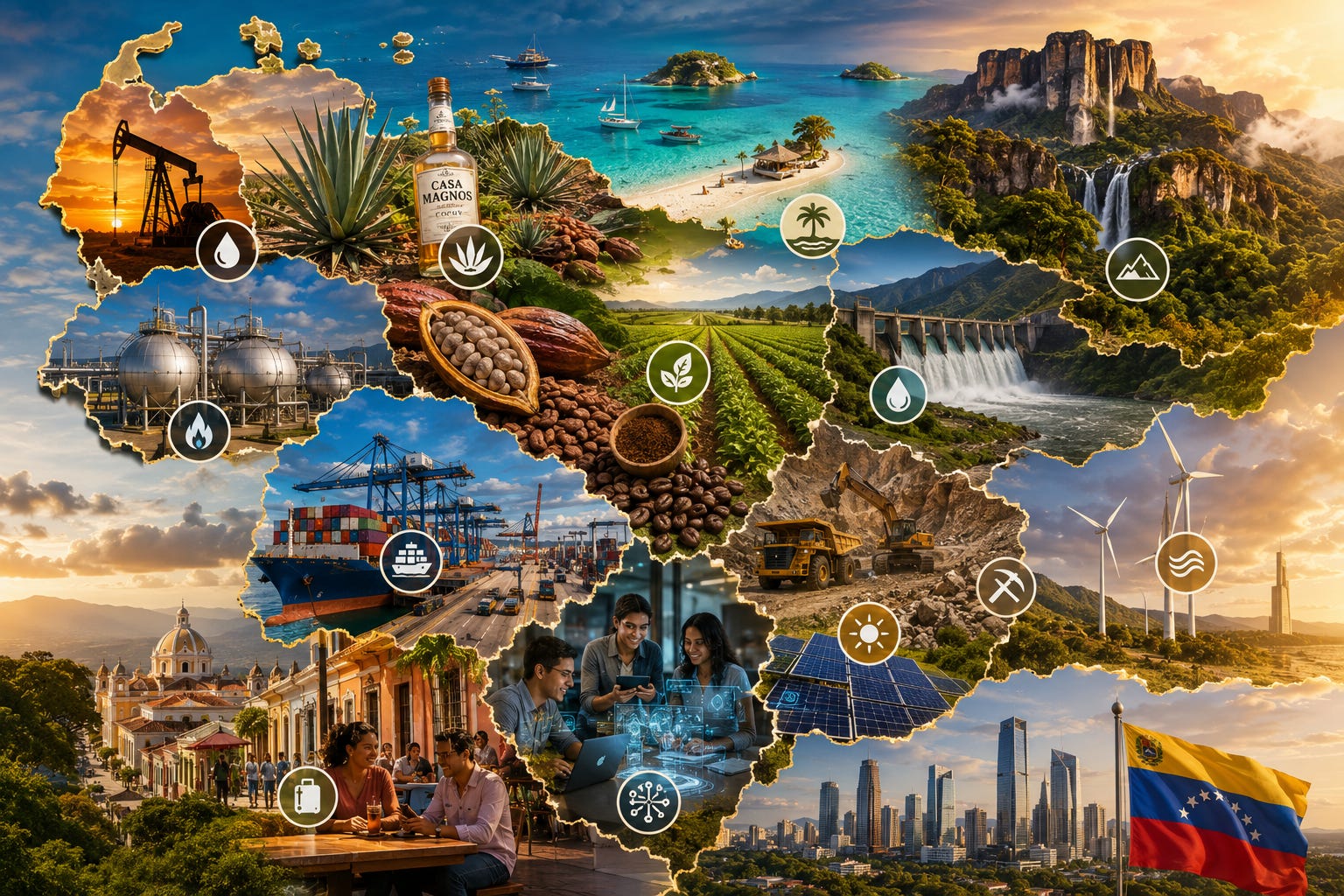
Throughout this series, I’ve argued that rebuilding Venezuela isn’t about finding a single industry capable of transforming the country. It’s about creating an economy where multiple industries reinforce one another. In the previous article, I wrote about why I believe energy is the foundation of that transformation and how artificial intelligence can become a force multiplier across nearly every sector. The natural question that follows is: what industries should Venezuela actually be building?
This is probably the question I’ve spent the most time thinking about over the last few months. In many ways, I’m not discovering anything that most Venezuelans don’t already know. We all grew up hearing that Venezuela has fertile land, extraordinary biodiversity, vast energy resources, beautiful beaches, mountains, rivers, and incredible tourism potential. None of that is new.
What has changed is the way I think about those opportunities. Every conversation I’ve had with entrepreneurs, investors, and industry experts eventually leads back to the same realization: Venezuela’s future shouldn’t depend on replacing one commodity with another. If our economy simply shifts from depending on oil to depending on lithium, AI, tourism, or any other single sector, we’ll eventually repeat many of the same mistakes.
The opportunity isn’t discovering another resource. It’s finally building an economy where those resources complement one another. Resilient economies are diversified economies.
One of the biggest lessons I’ve learned while studying countries that have successfully transformed themselves is that they rarely succeed because they discover a single breakthrough industry. They succeed because they build ecosystems where different sectors strengthen one another. Manufacturing benefits from reliable energy. Agriculture depends on transportation and logistics. Tourism benefits from infrastructure and safety. Universities produce the engineers and entrepreneurs who create new companies. Technology increases productivity across all of them.
That’s the lens through which I’ve started looking at Venezuela.
Agriculture is perhaps the opportunity that surprised me the most. Venezuela possesses more than thirty million acres of arable land, multiple climate zones, abundant freshwater resources, and the ability to grow crops throughout the year. Coffee, cacao, tropical fruits, sugarcane, rice, corn, livestock, and aquaculture all have significant long-term potential. Yet what excites me isn’t simply producing more commodities. It’s moving further up the value chain.
Take cacao as an example. Venezuela has long been recognized for producing some of the highest-quality cacao in the world, but much of the value has historically been captured elsewhere through processing, branding, and finished consumer products. The same applies to coffee, tropical fruits, seafood, and many agricultural products. Rather than thinking only about exports of raw materials, I think Venezuela has an opportunity to build globally recognized food brands, modern processing facilities, precision agriculture companies, and AgTech startups that serve both domestic and international markets.
The same principle extends beyond food. Over the past few years, I’ve been fascinated by the revival of cocuy, a traditional Venezuelan spirit distilled from agave plants that grow naturally in the country’s arid western regions. For decades, it remained relatively unknown outside Venezuela, but a new generation of entrepreneurs has begun transforming it into a premium product capable of competing on the global stage.
One of my close friends is the owner of Casa Magnos, and after trying it for the first time, I remember thinking it was genuinely one of the best spirits I had tasted in years, like a really good Tequila. What impressed me wasn’t just the quality of the product. It was what it represented. Instead of exporting another raw commodity, entrepreneurs were taking a uniquely Venezuelan tradition, investing in craftsmanship, branding, design, and storytelling, and creating something with significantly higher value.
I think that’s exactly the kind of thinking Venezuela needs more of. Whether it’s cacao becoming premium chocolate, coffee becoming specialty brands, cocuy becoming a world-class spirit, or tropical fruits becoming internationally recognized products, the opportunity isn’t simply producing more. It’s creating products that people around the world actively seek out because of their quality, authenticity, and identity.
Tourism is another industry that has stayed with me throughout this journey. Growing up in Venezuela, many of us almost took for granted how extraordinary the country’s geography really is. Only after living abroad did I begin to appreciate how rare it is for one country to contain Caribbean islands like Los Roques, the tepuis and waterfalls of Canaima National Park, the Andes mountains around Mérida, the beaches of Morrocoy, the winds of Adícora, the Amazon rainforest, and the vast plains of Los Llanos.
Most countries would be fortunate to have one of those destinations.
Venezuela has all of them.
Tourism, however, isn’t just about beautiful places. It’s an ecosystem that depends on airports, roads, hotels, restaurants, healthcare, security, digital connectivity, and entrepreneurship. Every tourist creates demand for dozens of small businesses. Hotels purchase food from local farmers. Restaurants employ chefs and waitstaff. Tour operators hire guides. Transportation companies move visitors around the country. Local artisans sell their products. One visitor can generate economic activity across an entire community.
That’s why I think tourism deserves a much larger place in conversations about Venezuela’s future.
Another opportunity that often receives less attention than it deserves is logistics. Geography is one of the few competitive advantages a country cannot manufacture, and Venezuela’s location is genuinely exceptional. Sitting between North and South America with access to both the Caribbean Sea and the Atlantic Ocean, Venezuela has the potential to become an important logistics, shipping, and trade hub for the region. Modern ports, efficient customs processes, improved highways, rail infrastructure, and digital trade systems could dramatically increase the country’s competitiveness while supporting manufacturing and exports.
Mining is another area where nuance matters. Venezuela possesses significant deposits of gold, iron ore, bauxite, nickel, coltan, and rare earth elements. Those resources will undoubtedly play an important role in the country’s economy, but I think the more interesting conversation is how to create value beyond extraction. Instead of simply exporting raw minerals, Venezuela should aspire to develop downstream industries that process those materials into higher-value products, creating skilled jobs, attracting investment, and strengthening domestic manufacturing capabilities.
The same idea applies to manufacturing more broadly. One of the biggest advantages Venezuela has compared to many countries is the combination of abundant energy resources, access to raw materials, strategic geography, and a highly educated diaspora. Those ingredients create the possibility of developing industries that would have been difficult to imagine a generation ago. Advanced manufacturing, food processing, specialty chemicals, aerospace components, battery materials, and industrial technology all become more realistic when energy, logistics, and human capital begin reinforcing one another.
As I’ve worked through these ideas, I’ve noticed a common thread.
Every opportunity I’ve described depends on another opportunity.
Agriculture depends on energy and logistics.
Tourism depends on infrastructure and entrepreneurship.
Manufacturing depends on energy, education, and ports.
Mining depends on technology, environmental stewardship, and transportation.
Artificial intelligence improves productivity across all of them.
That’s why I increasingly believe we should stop asking which industry will rebuild Venezuela.
No single industry will.
Countries don’t become prosperous because they find one winning sector. They become prosperous because they build economic ecosystems where success in one industry creates opportunities for another. That’s how Silicon Valley became more than software. It’s how Norway built an economy around energy while simultaneously investing in shipping, technology, and advanced engineering. It’s how countries like Singapore transformed strategic geography into global trade, finance, and logistics.
Venezuela has the opportunity to follow its own path.
One idea I’ve become increasingly convinced of throughout this journey is that rebuilding Venezuela isn’t about recreating the economy we had thirty or forty years ago. It’s about building an economy that is more diversified, more resilient, and more innovative than the one that existed before.
If we simply restore oil production without strengthening agriculture, tourism, entrepreneurship, manufacturing, and technology, we’ll remain vulnerable to the same cycles that have defined much of our modern history. But if we use our energy resources as the foundation for a broader industrial transformation, we have an opportunity to build something far more sustainable.
That transformation won’t happen overnight. It will require investment, education, infrastructure, sound institutions, and long-term thinking. It will require public and private sectors working together, entrepreneurs willing to take risks, and a diaspora willing to reconnect with the country.
It will also require something else.
People willing to build.
Every company that gets started, every farm that modernizes, every hotel that opens its doors, every technology startup that solves a real problem, every investor who believes in the country’s future, and every young professional who decides to stay and build a career contributes to something much larger than their own success.
They contribute to rebuilding an economy.
In the next article, I’d like to focus on the people behind that transformation. Throughout this series, I’ve talked about industries, technology, and opportunities, but countries aren’t rebuilt by industries alone. They’re rebuilt by entrepreneurs, engineers, teachers, investors, and communities willing to create something that didn’t exist before.
Ultimately, I believe Venezuela’s greatest natural resource isn’t oil, natural gas, or critical minerals.
It’s the people willing to build its future.