

Throughout this series, I’ve spent a lot of time thinking about what Venezuela could become.
I’ve written about the country’s energy potential, the role artificial intelligence could play in accelerating productivity, and why I believe a diversified economy built around industries like agriculture, tourism, logistics, manufacturing, and technology offers a much more resilient future than simply replacing one commodity with another.
As I was finishing the previous article, though, I realized I had been asking the wrong question.
The question isn’t whether those opportunities exist. Most Venezuelans already know they do.
We’ve grown up hearing about the country’s fertile land, its rivers, mountains, coastlines, mineral wealth, oil reserves, biodiversity, and strategic location. None of that is new. The challenge has never been identifying opportunities. It’s been creating the conditions for those opportunities to become sustainable industries.
That naturally leads to a much more interesting question. Who actually builds them?
It’s surprisingly easy to talk about economic development as though industries simply appear once the right policies are implemented or enough investment arrives. We speak about GDP growth, exports, infrastructure, or industrial strategy as if countries develop from the top down. But when you zoom in, economies are remarkably human.
Every company started because someone believed a problem was worth solving. Every employer was once a founder taking a risk. Every export industry that today feels inevitable began with a handful of people trying to build something that didn’t previously exist.
The more I’ve studied countries that have transformed themselves economically, the harder it has become to ignore the role entrepreneurs consistently play in that story.
This isn’t because entrepreneurs are somehow more important than teachers, engineers, doctors, scientists, or public servants. Quite the opposite. Successful entrepreneurs depend on all of them. What entrepreneurship does provide, however, is a mechanism for turning ideas into organizations, organizations into jobs, and jobs into economic growth.
When we think about tourism, for example, it’s easy to picture beaches, hotels, or national parks. In reality, tourism is an ecosystem. Behind every visitor are airlines, transportation companies, restaurants, software providers, marketing agencies, construction firms, architects, local guides, photographers, farmers, fishermen, artisans, and countless other businesses serving needs that most tourists never even notice.
The same is true for agriculture. Growing more food isn’t simply about planting crops. It requires irrigation systems, machinery, fertilizer, financing, logistics, food processing, packaging, exports, research, and increasingly, technology. Manufacturing, healthcare, mining, and energy all follow the same pattern. Large industries are really collections of thousands of businesses solving different parts of the same problem.
That’s one of the reasons I’ve become increasingly optimistic about entrepreneurship in Venezuela.
Earlier this year, while attending Venezuela Tech Week, I had the opportunity to meet founders building companies across a surprisingly diverse range of industries. Some were developing AI products. Others were working on fintech, logistics, healthcare, education, and enterprise software. None of them claimed to have the answer to Venezuela’s challenges, nor did they pretend entrepreneurship alone could solve them.
What stood out to me was something much simpler. They had decided to build.
That mindset may sound ordinary, but I don’t think it is. Building requires optimism. It requires believing that the future can be better than the present, even when the evidence isn’t always obvious. Every entrepreneur makes decisions today based on what they hope tomorrow will look like. In that sense, entrepreneurship is an investment in possibility.
As I’ve reflected on those conversations, I’ve found myself thinking just as much about another group of Venezuelans. The ones who no longer live there.
For years, we’ve understandably described the Venezuelan diaspora as one of the country’s greatest losses. Millions of people left in search of stability, opportunity, and security. Families were separated, institutions lost talent, and businesses lost experienced employees. There is no question that Venezuela paid an enormous price for that migration.
At the same time, I wonder if that’s only half the story.
Unlike many migration waves throughout history, a significant portion of the Venezuelan diaspora is highly educated. Many left after completing university degrees in Venezuela. Others pursued graduate education abroad. Today, Venezuelans work at leading technology companies, hospitals, universities, engineering firms, research institutions, investment funds, startups, and multinational corporations across the world.
Over the last two decades, millions of Venezuelans haven’t simply built new lives abroad. They’ve accumulated knowledge.
They’ve learned how world-class organizations operate. They’ve managed complex engineering projects, launched companies, led research teams, raised venture capital, developed products used by millions of people, built global supply chains, and worked inside institutions that have spent decades refining how they innovate and grow.
When viewed from that perspective, the diaspora becomes something much more interesting than a story of brain drain. It becomes one of Venezuela’s greatest strategic assets.
In many ways, it’s a globally distributed network of people who now understand how successful organizations function because they’ve helped build them.
Perhaps even more importantly, technology has fundamentally changed what it means to contribute to your country.
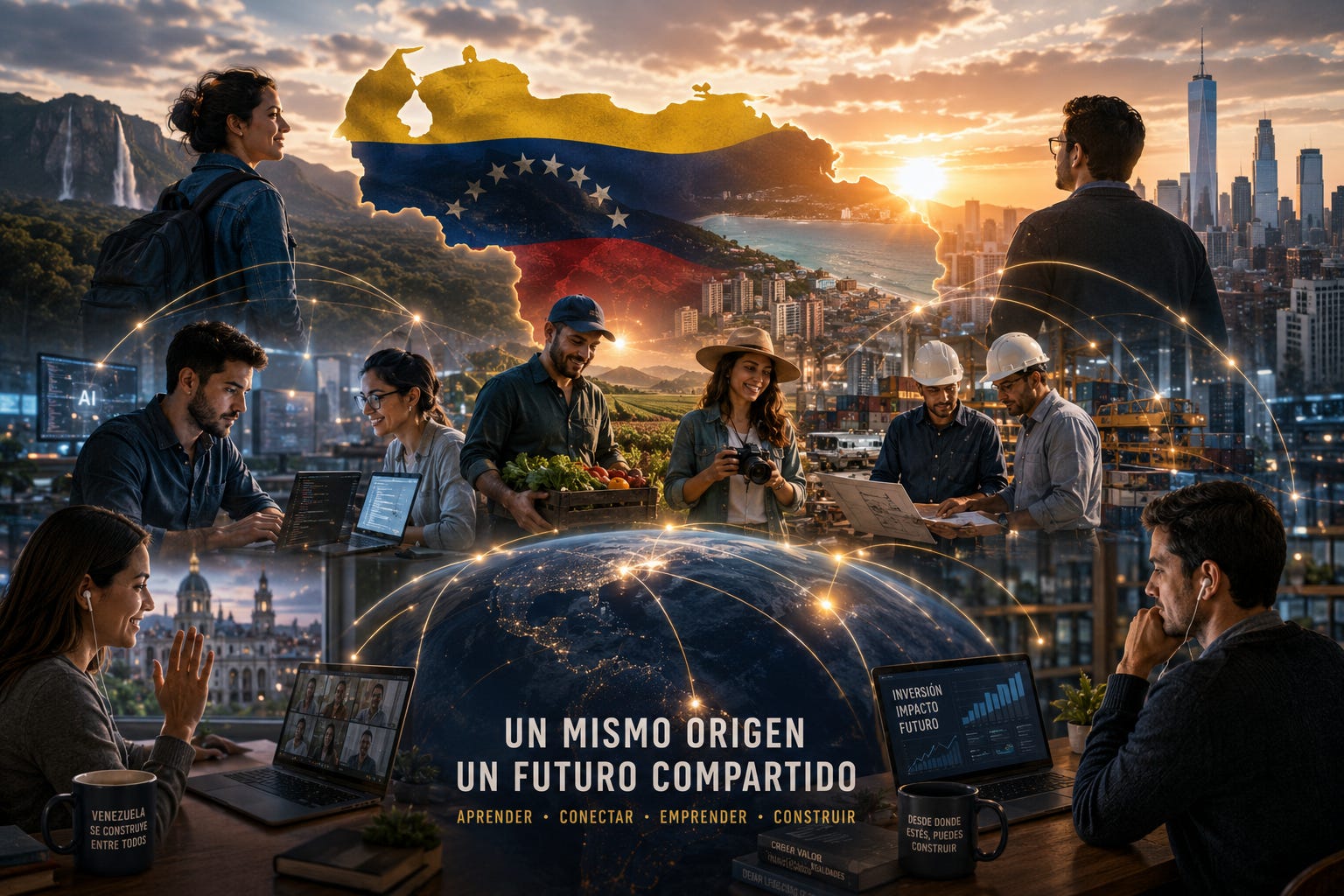
For most of history, helping meant physically being there. Today, that’s no longer entirely true. A founder in Miami can invest in a startup in Caracas. An engineer in Madrid can mentor a team in Valencia. A professor in Boston can teach students remotely. A venture capitalist in New York can back Venezuelan entrepreneurs. Artificial intelligence, remote work, and global communication have dramatically reduced the friction that once separated people from their home countries.
Contributing is no longer defined solely by geography. That realization has changed the way I think about my own future.
For a long time, I assumed that helping Venezuela meant that one day I would move back permanently. Today, I don’t think the answer is quite that binary. Building ODS has shown me that companies create opportunities that extend far beyond where they’re headquartered. Every engineer we hire develops skills that they’ll carry throughout their career. Every project exposes someone to new technologies and new ways of thinking. Every client engagement creates knowledge that compounds over time.
Those experiences don’t stay inside one company. Eventually they spread through the people who lived them.
That’s one of the reasons I remain optimistic.
Not because I think rebuilding Venezuela will be easy, or because I believe one company, one government, or one generation will solve every challenge the country faces.
I’m optimistic because I believe Venezuela already has something that many countries spend decades trying to develop. It has millions of people, both inside the country and across the world, who have accumulated the education, technical expertise, entrepreneurial experience, professional networks, and resilience needed to build extraordinary things.
The challenge isn’t finding talented people. It’s reconnecting them with the country’s future.
Earlier in this series, I mentioned Ric Elias and Puerto Rico’s FWD787 initiative. What I found compelling wasn’t the idea of convincing everyone to return home. It was the recognition that rebuilding a country isn’t only about physical infrastructure. It’s also about reconnecting a global community of founders, investors, engineers, educators, operators, and professionals around a shared belief that they can help shape what comes next.
I think Venezuela has the opportunity to do something similar.
As I look back across everything I’ve explored over these past months, I realize that this series was never really about oil, artificial intelligence, agriculture, or tourism.
Those were simply different ways of asking the same question. What gives a country the ability to create prosperity over the long term?
The answer, I think, isn’t found in any particular industry or natural resource.
It’s found in people.
People willing to learn.
People willing to invest.
People willing to teach.
People willing to mentor.
People willing to build.
And when I think about the talent that still exists inside Venezuela, combined with the experience that millions of Venezuelans have accumulated around the world, I find myself more optimistic than when I started writing this series.
Not because rebuilding will be easy.
But because I believe the people capable of doing it already exist. They just need the opportunity to write the country’s next chapter.