

This is the final part of my Rebuilding Venezuela series, although the conviction behind it began before I wrote the first article of this series. Earlier this year, I had already started working in Venezuela through my new business and having conversations about where we might be able to contribute. I had come to believe that it was time to stop treating the country’s future as something I might become involved with one day and start finding practical ways to help now. Then the earthquake happened. Like many Venezuelans abroad, I spent several difficult hours trying to reach my family, following the news and watching the damage unfold from a distance. The experience reinforced the belief that had already been developing in me: rebuilding Venezuela will be one of the defining challenges of our generation, and what we choose to do during the next few decades could influence the country for a very long time.
The earthquake was the reason I began writing this series, but it wasn’t the beginning of my interest in the work itself. In some ways, the series became an attempt to organize the questions I was already asking. What industries could Venezuela realistically develop? What infrastructure would they require? Where could technology accelerate progress? What could Venezuelans abroad contribute without necessarily moving back? One article turned into several, and before long I was spending a slightly unreasonable amount of my free time reading about energy systems, agriculture, manufacturing, tourism, logistics, artificial intelligence and the experiences of countries that had transformed their economies. I also began speaking with entrepreneurs, investors, engineers, academics, operators and industry experts who knew far more about each of those subjects than I did.
When I started researching this series, I wasn’t looking to discover Venezuela’s opportunities. Like most Venezuelans, I had grown up hearing about them. We all know the country has extraordinary natural resources, fertile land, breathtaking landscapes, abundant energy and a strategic geographic location. Those advantages have never really been the mystery.
What I wanted to understand was something different. If those opportunities are so obvious, why have so few of them become globally competitive industries? What would it actually take to build them today? A beautiful coastline does not automatically create a thriving tourism sector, just as fertile land does not automatically create a modern agricultural industry. Both require infrastructure, financing, logistics, regulation, technology, talent and, perhaps most importantly, thousands of entrepreneurs and businesses solving different pieces of the same problem.
That shift in perspective ended up changing the way I thought about almost everything else. I stopped asking what Venezuela could build and became much more interested in how countries actually build things.
That is probably the most important conclusion I reached throughout this series. Venezuela’s future will not be secured by choosing the correct industry and placing a large bet on it. Replacing dependence on oil with dependence on mining, tourism, artificial intelligence or any other single sector would eventually recreate many of the same vulnerabilities. Resilient economies are built when multiple industries develop together and begin strengthening one another. Reliable electricity makes manufacturing more competitive. Growing companies create demand for logistics, software and financial services. Better universities produce engineers, researchers and entrepreneurs. Agriculture supports food processing, packaging, machinery and exports. Tourism creates opportunities for restaurants, architects, transportation companies, guides, artisans, farmers and many other businesses that visitors may never notice. Over time, progress compounds because success in one area makes success somewhere else more likely.
This is also why prosperity is difficult to capture through a single statistic. We tend to describe successful countries using GDP, productivity, exports, inflation and foreign investment, all of which matter. But most people experience prosperity in much more ordinary ways. They notice whether electricity works without having to think about it, whether hospitals have the equipment they need, whether public spaces feel safe, whether a university degree leads somewhere, and whether a person who works hard can realistically improve their life. Prosperity is often less about spectacular moments than it is about ordinary moments becoming predictable. A country is doing well when people can make plans several years into the future without feeling foolish for trying.
When I imagine Venezuela succeeding twenty years from now, that is mostly what I picture. I imagine reliable electricity becoming so normal that nobody writes essays about it. Factories operate without interruption, hospitals function as expected, and families no longer plan their days around blackouts. Universities become places where students feel excited about the careers available to them, rather than assuming that graduation must be followed by departure. Venezuelan products become increasingly common outside the country; not only oil and raw materials, but coffee, cacao, specialty foods, software, engineering services, medical technology, industrial equipment and brands that compete because they are genuinely good. Visitors come to experience Canaima, Los Roques, Mérida, Morrocoy and the Amazon, but they leave talking just as much about the restaurants, hotels, guides, local businesses and quality of service they found along the way.
Technology would probably become less visible in that future, which may sound strange after dedicating an entire article to artificial intelligence. The most useful technologies eventually stop feeling remarkable and simply become part of how things work. Artificial intelligence will matter not because every Venezuelan company becomes an AI company, but because farmers use it to improve yields, doctors use it to support diagnoses, engineers use it to design infrastructure, teachers use it to personalize education, and small businesses use it to operate with capabilities that were previously available only to much larger organizations. The opportunity is not to build an economy around AI. It is to use AI, software and data to make nearly every part of the economy more productive.
The encouraging part is that some of this no longer feels entirely hypothetical. Since I started writing, I’ve continued having conversations with people who want to build in Venezuela or who are already doing it. Some are founders working on companies today. Others have industry experience and are beginning to explore where it might be useful. Some are considering investments, while others are looking for partners, talent or introductions. I now spend a surprising amount of time connecting people who probably should have known each other already. Not every conversation becomes a project, and not every project will work, but the network is clearly growing. Ideas that initially felt theoretical are beginning to become introductions, proposals, investments and actual work.
That has been one of the most enjoyable and unexpected results of writing the series. I initially thought people would mostly respond by agreeing, disagreeing or correcting something I had written. Instead, many reached out to tell me what they were building. Others wanted to know what opportunities I was seeing or whether I could connect them with someone. A few conversations have already begun turning into collaborations. The interesting part is not any one project but the accumulation of them. An ecosystem is ultimately a network of people who can find one another, exchange knowledge, provide capital, hire talent and solve problems together. The stronger those connections become, the more likely it is that good ideas turn into durable organizations.
There are broader signals worth noticing as well. Venezuela Tech Week brought founders, investors, mentors and operators together in Caracas for several days of meetings, presentations and conversations focused on building companies. Cashea recently announced a $100 million Series B investment dedicated entirely to expanding its products and operations in Venezuela, backed by institutions and investors from the United States and Latin America. Before committing, representatives from some of those funds traveled to the country to meet users, merchants and the team themselves. Yummy has grown from a delivery startup into one of the country’s most visible technology companies, while its founders and early backers have increasingly supported other Venezuelan startups through capital, experience and introductions. None of these examples proves that Venezuela’s economic future is guaranteed, but they do show that people are once again willing to build, return, invest and make long-term bets on the country.
I find those signals meaningful precisely because they are still imperfect. It would be easy to become carried away by one funding round, one successful company or one well-attended technology event. Venezuela still has major institutional, infrastructure and economic challenges, and optimism is not a substitute for dealing honestly with them. But waiting until every problem has been solved before deciding to build would mean waiting forever. Economies rarely recover because conditions become perfect and entrepreneurs politely arrive afterward. More often, people begin creating companies while conditions are still uncertain, and those companies gradually become part of the reason conditions improve.
That idea has also become closely connected to my own professional decisions. Helping rebuild Venezuela was one of the reasons I left a consulting job that was both comfortable and genuinely fun. I wasn’t running away from a bad experience. I worked with people I admired, served interesting clients and had the opportunity to solve difficult problems with some of the best teams in the industry. By almost every conventional measure, staying would have been an excellent decision. But I kept thinking about what I wanted the next twenty or thirty years of my career to be connected to, and I realized I wanted to build something that could eventually play a role, however small, in Venezuela’s future.
That does not mean I believe ODS will rebuild a country. One company cannot do that, and pretending otherwise would be ridiculous. What companies can do is create work, develop people and transfer knowledge. An engineer who learns to build a modern data platform carries that experience into every project that follows. A manager who learns how a strong organization operates may eventually lead another one. Someone who works with international clients develops standards, relationships and confidence that can later be applied somewhere else. The effects do not remain neatly contained within a company. People move, teach, mentor, invest and eventually build organizations of their own.
When I left my last job a client told me that he takes pride in what he does every day, but that hearing about my plans for Venezuela was inspiring because it connected work with something larger. I liked that observation, partly because he didn’t say that ordinary professional goals were unimportant. Building a good company, serving clients well and creating a strong life for your family are all worthwhile ambitions. But having the chance to connect that work to a project as significant as helping rebuild a country is an incredible source of motivation. It makes even the difficult or tedious parts of building a business feel connected to a longer story. I feel fortunate to have found something that can keep me interested for the next several decades, especially since it seems unlikely that we will run out of problems to solve.
In the previous article, I argued that one of Venezuela's greatest long-term assets may be the millions of Venezuelans who have spent the last two decades building careers, companies and expertise around the world.
Contributing no longer has to be a binary decision between moving back permanently and doing nothing. People can return for a year, spend part of their time there, work on specific projects or contribute entirely from abroad. Geography still matters, but technology has made participation much more flexible. That is important because rebuilding Venezuela will require far more people than those who decide to live there full time.
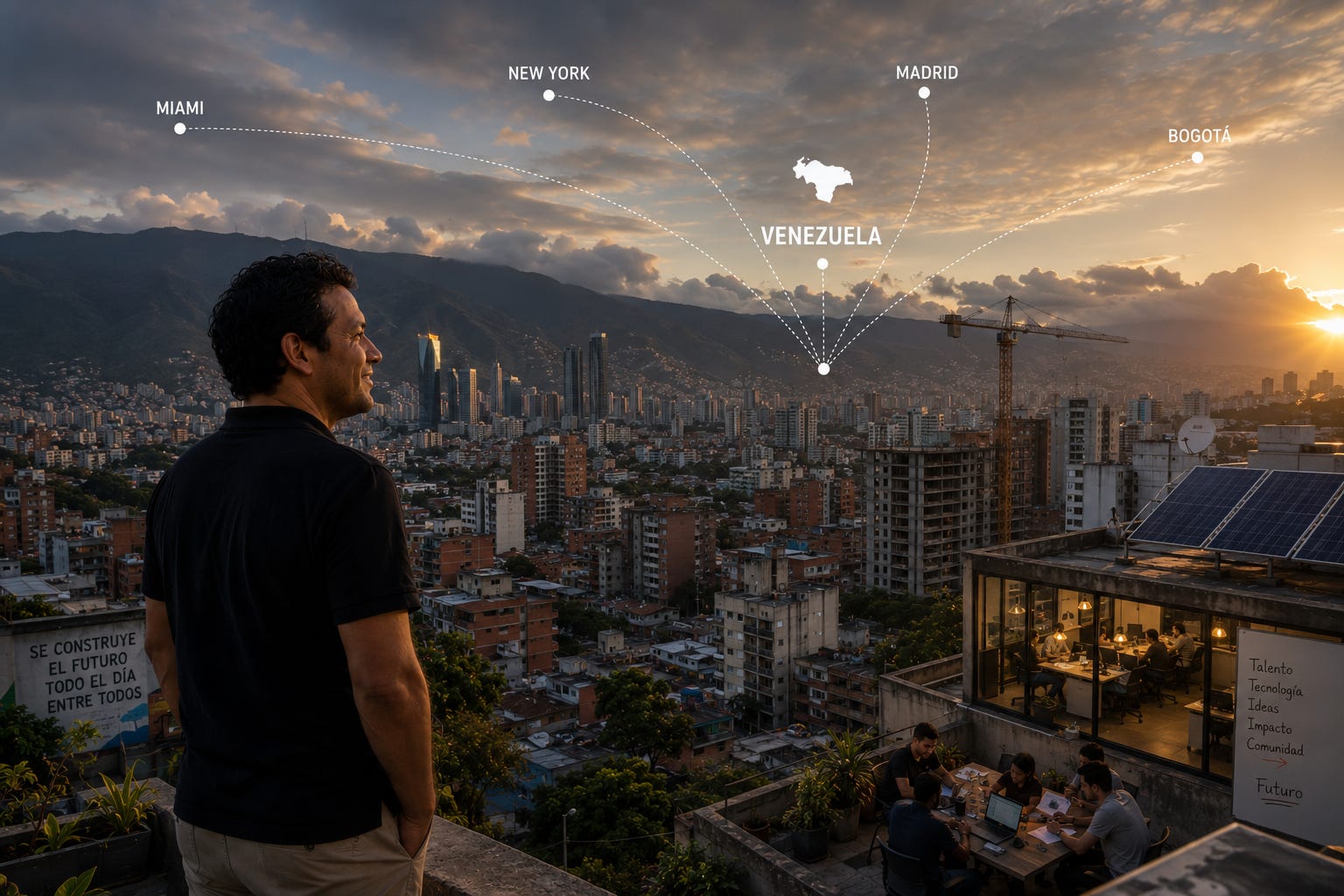
When I think about what I hope to see several years from now, I don’t picture everyone moving back or starting a company. I picture something more varied and, honestly, more fun. I hope to arrive in Caracas and unexpectedly run into friends at the airport who are visiting for a project, meeting with a team or exploring an investment. I hope to walk through the city and recognize people who are there for a conference, working with a nonprofit, helping modernize a family business, teaching a class or simply seeing whether an idea might work. Some will have returned permanently. Others will still live in Miami, Madrid, Bogotá, New York or wherever their lives have taken them. The specific arrangement matters less than the fact that more of us are involved.
I also hope those encounters become normal enough that we stop treating every person who contributes as an exceptional story. Perhaps one friend will be running a company while another works for one. Someone else may be investing, mentoring, teaching, conducting research or opening doors for other people. Many will contribute through work that receives little public attention but is essential to making everything else function. A country does not need everyone to become a founder, nor would that be particularly practical. It needs people doing useful work across thousands of organizations and industries, gradually raising the standard of what is possible.
That may be the clearest picture of success I can offer after writing this series. It is not one transformational project, a dramatic announcement or a return to an idealized version of the past. It is a country where more things work, more people build, and the future feels open enough that talented people can imagine themselves in it. It is the gradual creation of institutions, companies and communities that become stronger with time. Most importantly, it is a shift from spending every conversation remembering what Venezuela used to be toward becoming curious about what everyone is working on now.
I began this series because the earthquake made the country’s future feel urgent, but I was already trying to contribute before I wrote the first article. Writing these essays gave me a reason to study the subject more seriously, ask better questions and meet people I probably would not have found otherwise. It also made me more optimistic, although hopefully not irrationally so. Venezuela’s problems are real, rebuilding will take decades, and plenty of projects will fail along the way. Still, the number of people who are already building is much larger than I realized when I started.
I hope you enjoyed this series and feel inspired to join the effort in whatever way makes sense for you. Feel free to reach out if you want to continue the conversation, are curious about what I’m working on and what opportunities exist, or need me to connect you with someone. There is a good chance I know somebody you should meet, and an equally good chance that you know somebody I should meet. Either way, I’d be happy to hear from you.
And now, let’s get to work.