

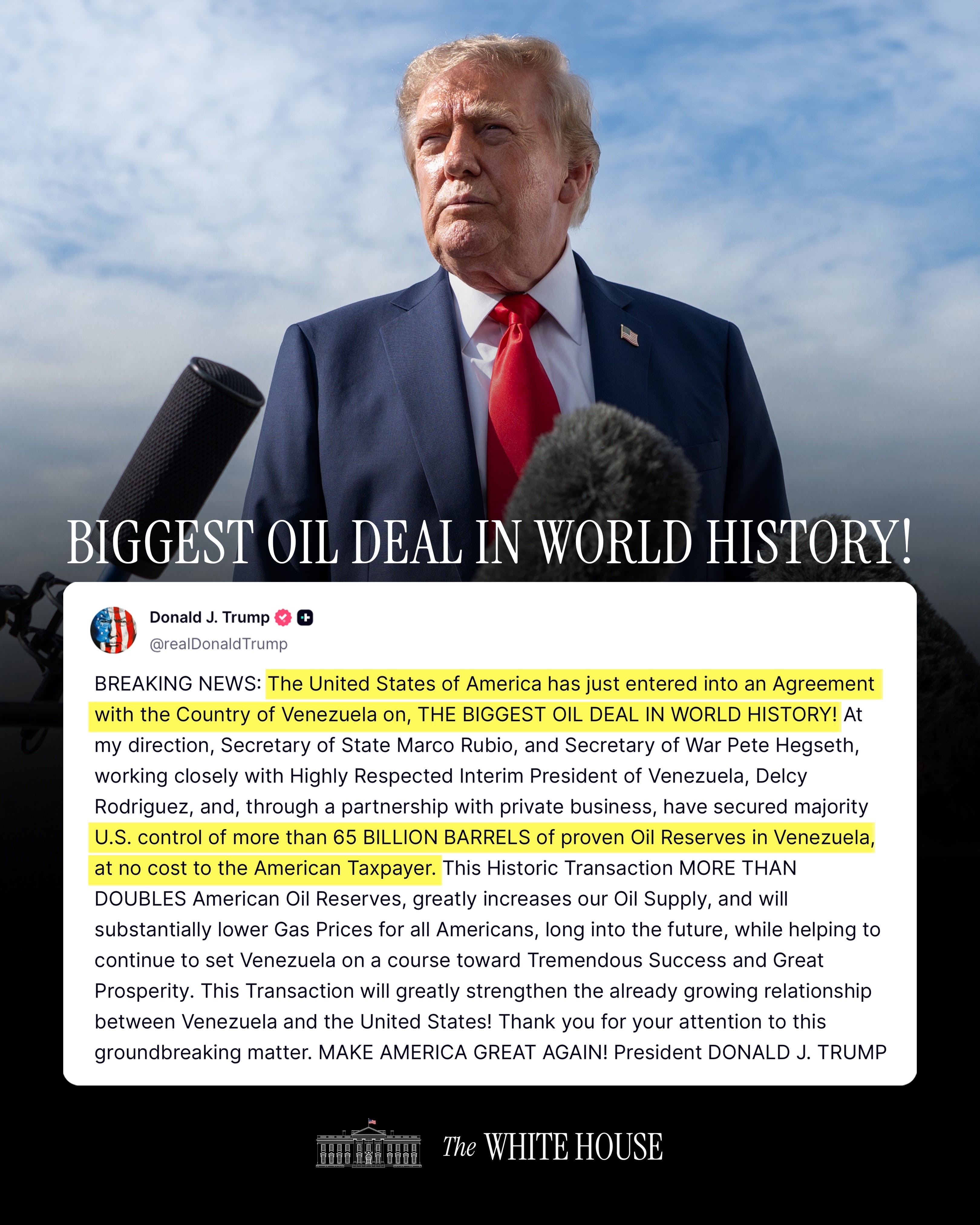
I know Venezuelans will have very different opinions about the oil agreement announced yesterday between Venezuela and the United States. That is understandable. The announcement is less than 24 hours old, many of the details are still unclear, and there are legitimate questions about its structure, legality, economics, and what it means for Venezuela in the long term.
But I keep coming back to something that I have seen throughout my life as a Venezuelan: sometimes we think about our country emotionally when we need to think about it pragmatically.
Was this the perfect deal for Venezuela? Probably not.
Is giving the United States majority control over the development of more than 65 billion barrels of Venezuelan oil something that should be examined carefully? Absolutely.
But I think there is another, much more important question:
Will Venezuela and Venezuelans be better off because of it?
If the answer is yes, then we should at least be willing to look at the agreement through that lens.
Oil in the Ground Has Never Been Enough
For generations, Venezuelans have proudly repeated the same fact: we have the largest proven oil reserves in the world.
And yet, what has that fact meant for the average Venezuelan over the last two decades?
We had enormous reserves while our economy collapsed. We had enormous reserves while millions of Venezuelans left the country. We had enormous reserves while infrastructure deteriorated, companies closed, employment disappeared, and basic public services became unreliable.
The oil was always there.
The prosperity wasn’t.
Natural resources don’t automatically create wealth. Productive industries do. Investment does. Infrastructure does. Technology does. Human capital does. Institutions do.
For years, Venezuela also developed deep economic and energy relationships with countries including China, Russia, and Iran. Those relationships did not produce the broad-based economic development Venezuelans desperately needed.
So when I hear the argument that Venezuela is “giving away its oil,” I understand the emotional reaction. Our natural resources are part of our national identity.
But pride in what exists underneath our soil has very little value if we cannot turn it into a better life above it.
What $100 Billion of Investment Could Actually Mean
The announced agreement covers 17 strategic oil fields representing more than 65 billion barrels of proven reserves, and Venezuelan and U.S. officials have said it could attract approximately $100 billion in private investment.
Whether that entire amount materializes remains to be seen. There are significant infrastructure, legal, political, and execution challenges ahead.
But imagine even a meaningful portion of it does.
Developing those fields requires far more than drilling wells. It requires power generation, roads, ports, pipelines, equipment, engineering, construction, logistics, housing, telecommunications, cybersecurity, software, professional services, environmental services, financial services, restaurants, hotels and thousands of workers.
Those companies employ people. Those people spend money. Local businesses grow around them. New suppliers emerge. Skills develop. Infrastructure gets built.
And eventually, some of those capabilities move beyond oil.
That is the part of this conversation that interests me the most.
This Is Exactly the Thesis Behind Rebuilding Venezuela
When I started writing my Rebuilding Venezuela series earlier this year, one of my central arguments was that oil should be a foundation for Venezuela’s next chapter, not the entire strategy.
Venezuela needs energy investment because almost every other industry depends on reliable energy and infrastructure. But the objective shouldn’t be to rebuild the old Venezuela where the entire economy revolves around PDVSA and the price of a barrel of oil.
It should be to use this moment to build something much broader.
Agriculture. Technology. Tourism. Manufacturing. Financial services. Mining. Renewable energy. Logistics. AI. Entrepreneurship.
A large, long-term commitment from American companies could help create the economic ecosystem that makes investment in those other industries more attractive as well.
And importantly, the economic relationship between Venezuela and the United States is not a one-way street.
The United States gains access to an enormous energy resource in its own hemisphere. American companies gain investment opportunities. Venezuela gains capital, technology, expertise, employment and potentially a much faster path toward rebuilding an industry that would otherwise require enormous amounts of capital.
That sounds to me like the beginning of a mutually beneficial relationship.
But Investment Alone Isn’t Enough
There is still a major piece missing.
Democratic transition and institutional stability.
If Venezuela wants this investment cycle to extend beyond oil and become sustainable for decades, investors need to know that contracts will be respected, property rights will be protected, disputes can be resolved fairly, and the rules won’t suddenly change with the political environment.
In other words, Venezuela needs juridical security.
A democratic transition would not only fulfill what millions of Venezuelans have been waiting for politically. It would also send one of the strongest possible economic signals to the rest of the world: Venezuela is ready to become investable again.
Interestingly, some of that groundwork is already beginning. The United States has recently modified several Venezuela-related licenses following investment reforms, while still requiring certain disputes to be resolved in jurisdictions such as the United States, United Kingdom, France, or Singapore.
That tells you something important.
Capital needs confidence.
Pragmatism Over Pride
There will be plenty of time to debate whether the United States received too much, whether Venezuela negotiated strongly enough, and whether every part of this agreement is fair.
Those are legitimate debates.
But I don’t think they should distract us from the bigger picture.
A country sitting on extraordinary natural resources while its population struggles is not winning simply because it technically owns those resources.
The objective isn’t to have the most oil.
The objective is to build a prosperous country.
If this agreement brings tens of billions of dollars of investment, creates thousands of jobs, rebuilds infrastructure, develops Venezuelan suppliers, reconnects the country with global capital and helps create the foundation for investment in other industries, then the average Venezuelan can be better off next year than they were last year.
That’s progress.
And after everything Venezuela has been through, I think progress matters more than pride.
Don’t read too much between the lines. I’m not arguing that every term of this agreement is good, that every question has been answered, or that Venezuela should accept unfavorable agreements indefinitely.
I’m simply looking at where Venezuela was, where it is today, and where this could lead.
From that perspective, I see this as a net positive for both Venezuela and the United States.
Now the challenge is making sure this becomes the beginning of Venezuela’s reconstruction, rather than another chapter in its long history of having extraordinary resources without translating them into extraordinary opportunities for its people.